
The Australian Dream or the Australian Scheme?

When someone sits across from us at MyMoneyMedic drowning in mortgage stress, we see a pattern that repeats too often to be random.

It’s not one dramatic moment. It’s a sequence.

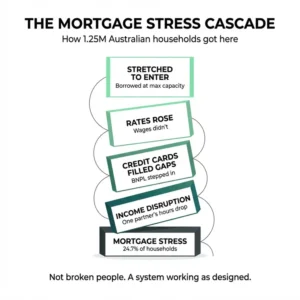
They stretched to enter the market because everyone said “get in now or you’ll be locked out forever.” They borrowed at the top of their capacity because property “always goes up.” Then rates rose. Costs rose. Wages didn’t.

Credit cards filled the gaps. Buy Now Pay Later stepped in. Tax debt lingered. The mortgage remained untouchable.

By the time they reach out for help, they’re emotionally exhausted. And they blame themselves.

That’s the moment we know the system isn’t broken. It’s working exactly as designed.
The System Produces the Outcome It Was Built For

Banks profit from larger loans over longer terms. Property demand benefits from urgency and FOMO. Household debt fuels economic growth.

When families are leveraged to the edge, stressed, and dependent on continued growth to stay afloat, that isn’t an accident. It’s an outcome.

As of November 2025, 24.7% of Australian mortgage holders are classified as “At Risk” of mortgage stress. That’s 1.25 million households where mortgage repayments consume a dangerous portion of income, leaving minimal buffer for life’s inevitable disruptions.

The dream only works if nothing goes wrong for 30 years.

Life doesn’t work like that.

Normal Life Exposes Maximum Leverage

The most common trigger we see isn’t dramatic. It’s income disruption.

One partner goes on parental leave. One income drops due to job change or redundancy. A small business owner has three slow months.

That’s it.

Suddenly, a household that “qualified comfortably” can’t breathe.

Most families don’t borrow based on surplus. They borrow based on maximum serviceability. Two full incomes assumed. Minimal lifestyle change assumed. Rate buffers that feel theoretical until they aren’t.

When one income softens, the margin disappears.

The mortgage was manageable as long as both engines were running perfectly. That’s the fragility.

Roy Morgan’s research confirms that unemployment has the largest impact on income and mortgage stress. Yet affordability assessments assume two full-time incomes remain stable indefinitely.

Among lower socio-economic groups, full-time employment among mortgage holders fell by 11.6% year-over-year. Employment assumptions collapse quickly for vulnerable households.

The Banking Assessment Disconnect

Here’s the uncomfortable truth about affordability assessments.

Most people hear: “You can afford this mortgage.”

Banks are calculating something different.

Income is treated as fixed and ongoing

Banks look at your current declared income and assume it keeps flowing, unchanged, forever. Full-time salary? Assumed stable. Bonus or overtime? Partially counted. Side gigs? Sometimes ignored.

Reality: Income isn’t guaranteed. Promotions stall. Hours get cut. Businesses fluctuate. Parental leave happens.

Expenses are treated as generic or minimal

Banks use broad expense categories, not your actual spending. They assume a “basic lifestyle” number for groceries, utilities, insurance. Car loans, childcare, school fees, subscriptions? Factored in minimally or ignored.

Reality: Day-to-day living costs are higher than these benchmarks and add up quickly.

Stress tests are theoretical

Banks might add a 2-3% buffer for interest rate increases. But it’s applied to the mortgage only, not your total household cashflow. It assumes you adjust perfectly without real-life friction.

Reality: Small rate rises plus normal life expenses equals immediate pressure, not a buffer.

Australian banks routinely approve loans at 5-7 times annual income. The average home loan debt is now $327,514 according to NAB’s 2024 data, while average household gross disposable income was only $139,064.

Debt is growing twice as fast as income.

No human psychology is accounted for

Banks calculate numbers. They don’t account for financial stress impacting decisions, emotional spending, or risk tolerance.

Reality: Even when clients can technically make payments, the mental load is crushing. Sleep, focus, relationships all suffer.

The formula answers: “Could this borrower service a loan under ideal conditions?”

Not: “Can this household live, save, and respond to life while paying this mortgage?”

That gap is exactly where stress builds.

The Tax Incentive Amplifier

Negative gearing by property investors reduced personal income tax revenue by $10.9 billion in the 2023-24 financial year. That’s up from $6.7 billion in 2014-15.

That’s $10.9 billion in foregone revenue effectively subsidizing property speculation while first-home buyers compete against tax-advantaged investors.

In 2022-23, about 1.1 million Australians were negatively geared. That’s 49.4% of all property investors gambling on capital gains to offset years of losses.

The Reserve Bank of Australia stated in 2003 that resources and finance are being disproportionately channeled into property investment, with tax effectiveness being an important selling point used by property promoters.

Tax policy, not housing need, is driving investment behavior.

Research by the Australian Housing and Urban Research Institute reveals that most negatively geared investors buy existing dwellings rather than building new homes. The policy inflates prices for existing stock without meaningfully increasing housing supply.

It’s a demand accelerator disguised as a supply solution.

The 5% Deposit Scheme: Solution or Accelerant?

From October 1, 2025, the Australian Government 5% Deposit Scheme was expanded with no income caps, no waitlists, and higher property price caps up to $1.5 million in parts of NSW.

First-home buyers can now enter the market with minimal equity and maximum exposure to rate fluctuations and life disruptions.

The scheme removes Lenders Mortgage Insurance but requires the property to remain owner-occupied with principal and interest repayments for up to 30 years.

If borrowers fail to meet ongoing obligations like losing a job or needing to relocate, the guarantee may no longer apply. They could face paying LMI or additional costs at their most vulnerable moment.

Parliamentary Budget Office modeling shows the scheme is highly sensitive to assumptions around interest rates, house price growth, and default rates. Default rates are projected at 0.3% annually.

This assumes ideal conditions over 30 years. The exact fragility pattern we see collapsing when normal life happens.

The Household Debt Reality

Australian household debt reached a record $3.33 trillion in June 2025. That’s a 6% increase in just one year.

The average Australian household now carries $313,633 in total debt, with mortgage debt alone representing 135% of household disposable income.

Australia has the fifth-highest household debt-to-income ratio among OECD countries at 211%. The average household owes more than twice what it earns annually.

We’re borrowing two years of income to fund our lifestyle and housing.

The debt-to-income ratio hit 182% in Q4 2024, tracking near record highs. This wasn’t an accident. It’s the predictable outcome when banks approve loans at maximum serviceability and tax policies incentivize speculation over genuine housing needs.

The Stress Distribution Problem

Mortgage stress hasn’t eased evenly.

While higher-income households have found relief, stress has actually increased among the lowest two socio-economic quintiles by over 5% year-over-year.

Relief from rate cuts is bypassing the 40% of Australians who need it most.

Even as interest rates dropped, mortgage stress surged in June 2025 to 28.4%. The highest since January 2025.

Why? Because households were borrowing larger amounts, chasing rising property prices with their newfound “affordability.”

The system encourages maximum leverage the moment conditions slightly improve.

Median mortgage repayments peaked at 47.1% of median household income in September 2024 before dropping to 45% by September 2025. Still far above the traditional 30% mortgage stress threshold.

Nearly half of household income consumed by housing before accounting for food, transport, childcare, or savings.

Why People Don’t Stress-Test

It’s not because people are careless.

Optimism bias: We naturally assume the future will resemble the present. Two stable incomes today feel permanent.

Social proof: Everyone else is borrowing big. If your peers are stretching, stretching feels normal.

Lending framework psychology: When a bank says you can borrow $1.2M, most people hear “you can afford $1.2M.” They don’t hear “you can survive $1.2M under ideal assumptions.”

No one models the downside in real terms: Very few borrowers sit down and calculate what happens if one income drops 30%, rates rise another 1-2%, or they need $20k unexpectedly.

They’re shown approval capacity, not fragility thresholds.

The Independent Advice Vacuum

Access to unbiased financial wellness guidance is rare.

Most advice comes from parties with skin in the game. Mortgage brokers earn commissions on loan size. Real estate agents benefit from higher prices. Bank employees have lending targets.

Financial literacy is rarely taught early or practically.

When families need independent perspective on whether they should stretch for that property, where to find it?

The gap between what’s approved and what’s sustainable requires someone to map both scenarios clearly, calmly, without judgment.

At MyMoneyMedic, we map the official bank-approved scenario and the real-life cashflow scenario.

Once clients see the divergence, decisions change. Borrowing less. Building buffers. Planning strategically rather than hoping for ideal assumptions.

The Generational Impact

Today’s policies are mortgaging future generations’ financial and mental wellbeing.

Young Australians entering the market face a choice: stretch beyond comfort or watch homeownership slip away.

The Australian dream has become a 30-year bet that nothing will go wrong.

Babies. Career shifts. Business cycles. Aging parents. School fees. Burnout.

Life transitions are predictable. But our borrowing decisions assume stability.

The problem isn’t ambition. It’s building a 30-year commitment on a 12-month snapshot.

The Path Forward: Clarity Over Leverage

We don’t sit across from people and tell them the system is rigged.

We sit with them and say: “You’re not bad with money. You’re in a high-pressure structure without visibility.”

When we map their numbers clearly, something powerful happens.

They see where the pressure truly sits. They understand their risk exposure. They regain agency.

Once there’s clarity, there’s choice.

The real Australian Dream isn’t just owning a house.

It’s sleeping at night. Not fearing every rate rise. Having buffers. Having options. Feeling in control.

Home ownership can absolutely be part of that dream. But only if it’s aligned with cashflow reality, not social expectation.

What We Believe

The system won’t change overnight.

But individuals can change how they engage with it.

That’s where power comes back.

When someone realizes they’re not broken, that they’ve simply been operating inside a system that rewards maximum leverage, everything shifts.

Not into fear. Into strategy.

When clients stress-test properly, they borrow differently. They build buffers first. They think in cashflow, not just asset value. They prioritize flexibility.

The dream isn’t fragile if it’s built with margin.

At MyMoneyMedic, we’re building a holistic finance health and wellbeing ecosystem to democratize financial wellness solutions. We’re not just another financial advisor.

We’re financial stress specialists focused on data privacy, trust, and care.

Because the real crisis isn’t just about property prices.

It’s about the mental, physical, and emotional toll of carrying debt that looks affordable on paper but crushes people in reality.

And when we help someone see their numbers clearly, map their actual risk, and build a plan with breathing room, that’s when the Australian dream becomes possible again.

Not as a scheme. As a choice.

 

Why Young Aussies Need Tax Reform

Is the Tax System Fair for Young Australians?

Australia’s tax system has long supported economic growth and stability. However, recent commentary reported by The Age highlights concerns that the current structure may be placing heavier burdens on younger generations.

A leading tax reform architect has argued that the system leans too heavily on income taxes while offering significant concessions in areas like property and superannuation. As a result, younger Australians — who are still building assets — may feel they are contributing more while receiving fewer structural advantages.

While that might sound discouraging, understanding the system is the first step toward navigating it wisely. At MyMoneyMedic (MMM), we believe clarity leads to confidence — and confidence builds opportunity.

What Are the Core Concerns?

Here are the key issues being discussed:

1. Heavy Reliance on Income Tax

Australia collects a significant portion of revenue from personal income tax. Younger workers, who rely primarily on wages, can feel this impact most directly. According to the Australian Treasury, income tax remains one of the largest sources of federal revenue.

2. Asset-Based Tax Concessions

Policies such as capital gains tax discounts and negative gearing often benefit Australians who already own property or investments. Younger people trying to enter the housing market may not access these benefits immediately.

3. Intergenerational Imbalance

As the population ages, government spending on healthcare and pensions increases. Data from the Australian Bureau of Statistics shows Australia’s demographic shift is ongoing, which may shape future fiscal decisions.

However, reform discussions are not about creating division — they are about improving sustainability and fairness across generations.

What This Means for Your Financial Journey

Tax reform debates can feel political, but they ultimately affect:

  • Your take-home pay
  • Your ability to save for a home
  • Your long-term wealth-building strategy
  • Government investment in services

The positive news? Financial awareness reduces disadvantage. Even within imperfect systems, strategic planning makes a powerful difference.

Practical Tips for Young Australians

Here’s how to stay proactive, regardless of policy outcomes:

1. Maximise Tax Efficiency

Understand deductions, offsets, and super contributions. The Australian Taxation Office provides free tools and guidance.

2. Build Assets Early

Even small, consistent investments compound over time. Starting early is more powerful than starting big.

3. Strengthen Income Growth

Invest in education, certifications, and skill-building. Higher earning capacity offsets tax pressures long term.

4. Budget With Purpose

Clarity in spending ensures you’re directing money toward future goals — not just present expenses.

5. Stay Informed, Not Overwhelmed

Reform conversations evolve slowly. Avoid reactive decisions based solely on headlines.

🎥 Is Capital Gains Tax reform the answer to fixing the housing divide? | The Business | ABC NEWS

Take Control with the MyMoneyMedic App

Tax reform may take time. But your financial clarity doesn’t have to wait.

The MyMoneyMedic App empowers you to:

  • Track income and expenses clearly
  • Understand your saving capacity
  • Plan for long-term goals
  • Reduce money stress
  • Build financial confidence step by step

Instead of worrying about systemic change, focus on personal progress.

👉 Download MyMoneyMedic today on Google Play or the Apple App Store and start building a stronger financial future with clarity and hope.

We’re still improving the app & would love your feedback. Share your thoughts with us here:

📝 Submit your feedback

Final Thoughts: Fairness Starts with Financial Awareness

Australia’s tax system continues to evolve. Discussions about fairness and intergenerational balance are important for long-term sustainability.

Yet regardless of policy reform timelines, your financial wellbeing remains within your influence.

By staying informed, building smart habits, and using tools like MyMoneyMedic, you position yourself for resilience — no matter how the system changes.

Hope begins with understanding.
Clarity creates confidence.
And consistent action builds lasting financial strength.

Is Australia Losing the Fair Go?

Understanding the “Fair Go” Debate

Australia has long been known as the land of the “fair go” — a place where hard work creates opportunity and living standards steadily improve across generations.

However, recent commentary from economist Gary Stevenson, reported by ABC News, suggests growing inequality could challenge that tradition. Stevenson argues that rising asset prices — particularly property — are widening the gap between those who own assets and those who don’t.

While this conversation may feel concerning, it also presents an opportunity: greater awareness can lead to better personal financial decisions. At MyMoneyMedic (MMM), we believe clarity creates empowerment — and empowerment builds hope.

📊 What’s Driving the Concern?

Several structural trends are shaping Australia’s economy:

🏠 1. Rising Asset Prices

Property values have grown significantly over the past decade, especially in cities like Sydney and Melbourne. When housing grows faster than wages, entering the market becomes harder for younger Australians.

📈 2. Wealth Concentration

Those who already own property or shares may see their wealth increase, while renters or lower-income households struggle to build assets.

💼 3. Wage Growth vs Inflation

Data from the Australian Bureau of Statistics shows wages have improved recently, but cost-of-living pressures still weigh on many families.

🏦 4. Interest Rates & Policy

The Reserve Bank of Australia adjusts interest rates to manage inflation — but higher rates can increase mortgage stress in the short term.

Together, these forces can create the feeling that opportunity is uneven. Yet importantly, awareness gives you the chance to plan strategically.

🌱 What This Means for You

Economic inequality discussions often focus on national policy. However, your personal financial wellbeing is shaped by daily decisions.

Here’s the positive perspective:

  • Financial literacy reduces disadvantage.
  • Budget clarity increases control.
  • Consistent investing builds long-term wealth.
  • Skill development strengthens earning potential.

Even in uncertain economic environments, practical steps create forward momentum.

💡 Practical Tips to Strengthen Your Position

✅ 1. Track & Optimise Cash Flow

Understanding exactly where your money goes each month is the foundation of control.

✅ 2. Build Assets Gradually

If property feels out of reach right now, start with accessible investments like ETFs or high-interest savings accounts.

✅ 3. Increase Income Potential

Upskilling or professional certifications can significantly improve long-term earning power.

✅ 4. Protect Against Risk

Maintain emergency savings to buffer against economic uncertainty.

✅ 5. Stay Calm During Headlines

Economic commentary can sound dramatic. Focus on data, long-term trends, and your personal strategy.

🎥 Gary Stevenson warns Australia’s housing future is on the brink | The Business | ABC NEWS

📱 Take Control with the MyMoneyMedic App

When conversations about inequality dominate headlines, it’s easy to feel powerless. But your financial future is still in your hands.

The MyMoneyMedic App helps you:

  • Monitor spending patterns
  • Create structured savings plans
  • Track debt reduction progress
  • Set realistic financial goals
  • Gain clarity through personalised insights

Instead of worrying about macroeconomic trends, focus on micro-level progress.

👉 Download MyMoneyMedic now on Google Play or the Apple App Store and start building financial resilience with clarity and confidence.

We’re still improving the app & would love your feedback. Share your thoughts with us here:

📝 Submit your feedback

🌟 Final Thoughts: The Power of Personal Agency

Australia’s economic landscape is evolving. Discussions about fairness, inequality, and opportunity are important — and they may influence future policy decisions.

However, while governments debate structural reform, you can take proactive steps today.

Hope begins with awareness.
Clarity creates confidence.
And consistent action builds financial strength.

With the right knowledge and tools like MyMoneyMedic, you can thrive — regardless of broader economic shifts.

Cafés & Cost Pressures: What It Means

Why Are Cafés Struggling?

Australia’s beloved café and restaurant culture is under pressure. Across the country, many small hospitality businesses are reaching what industry leaders describe as “crisis point.”

According to recent reporting by 9News, rising operational costs — including rent, wages, insurance, utilities, and ingredients — are squeezing profit margins. At the same time, customers are spending more cautiously due to broader cost-of-living pressures.

While this news may sound concerning, understanding why it’s happening empowers us to respond wisely. At MyMoneyMedic (MMM), we believe clarity reduces anxiety — and informed decisions create resilience.

📊 What’s Driving the Hospitality Crunch?

Several economic factors are colliding at once:

📈 1. Rising Business Costs

Energy bills, supplier prices, and wage increases have significantly impacted hospitality operators. Resources from the Australian Bureau of Statistics show that inflation has affected both goods and services over recent years.

💳 2. Reduced Consumer Spending

With higher mortgage repayments and rent increases, many households are cutting discretionary spending — including dining out.

🏠 3. Rental & Property Pressures

Commercial lease costs remain high in many areas, particularly in capital cities like Sydney and Melbourne.

👥 4. Staffing Challenges

Labour shortages and wage adjustments are necessary for fairness — but they also increase operating expenses for small businesses.

Together, these pressures create a difficult environment for café and restaurant owners — many of whom are small family-run businesses.

🌱 The Bigger Picture: Why This Matters to You

Even if you don’t own a café, hospitality challenges reflect broader economic shifts:

  • When businesses struggle, employment can be affected.
  • Reduced competition may push prices higher.
  • Local communities can lose important social spaces.

However, economic cycles are normal. Industries adjust. Consumers adapt. And opportunities emerge.

This is where personal financial resilience becomes powerful.

💡 Practical Tips to Stay Financially Strong

Here’s how you can respond proactively — no matter what’s happening in the economy:

✅ 1. Review Your Discretionary Spending

Dining out is enjoyable, but balance is key. Small adjustments can create meaningful savings without eliminating joy.

✅ 2. Support Local — Strategically

If possible, support small businesses mindfully. Choosing value deals or weekday specials helps both your wallet and local operators.

✅ 3. Strengthen Your Budget Plan

Track spending categories clearly. Awareness leads to better decision-making.

✅ 4. Build an Emergency Buffer

Aim for at least 3 months of essential expenses. This protects you from sudden job or income shifts.

✅ 5. Focus on Income Stability

Upskilling, side income, or reviewing employment opportunities can provide additional security.

🎥 Why Australians are falling behind | The Business | ABC NEWS

For more insight into Australia’s cost-of-living environment and its impact on businesses, watch:

📱 Take Control with MyMoneyMedic

Economic headlines can feel overwhelming — but your financial wellbeing doesn’t have to be.

The MyMoneyMedic App helps you:

  • Track your daily spending
  • Categorise expenses automatically
  • Set savings goals
  • Monitor financial health in real time
  • Reduce money stress with clear insights

Instead of reacting to crisis headlines, take calm, confident action.

👉 Download MyMoneyMedic today on Google Play or the Apple App Store and build resilience with clarity and hope.

We’re still improving the app & would love your feedback. Share your thoughts with us here:

📝 Submit your feedback

🌟 Final Thoughts: Challenges Create Opportunity

Australia’s café culture is resilient. While many businesses are navigating tough conditions, innovation and adaptation often follow challenging periods.

Similarly, your personal financial journey will have seasons — some tighter than others. The key is preparation, awareness, and positive action.

With the right mindset and tools like MyMoneyMedic, you can move forward confidently — no matter what the economy is doing.

Hope begins with clarity. And clarity leads to confident financial wellbeing.

3 Ways to Fix Australia’s Affordability

Understanding Australia’s Affordability Challenge

The rising cost of living has become one of the biggest concerns for Australians. From housing and groceries to energy bills and education, many households are feeling the pressure.

However, while the challenge is real, there are practical solutions being discussed — and importantly, there are steps you can take today to strengthen your financial wellbeing.

A recent analysis from Morningstar highlighted several structural reforms that could improve affordability across Australia. Rather than focusing on fear, let’s explore these ideas with clarity — and more importantly, what they mean for your financial future.

At MyMoneyMedic (MMM), we believe knowledge brings confidence. And confidence creates positive action.

🏠 1. Improving Housing Supply & Policy Settings

Housing affordability remains at the centre of Australia’s cost-of-living debate. While demand continues to grow due to migration and population increases, supply hasn’t kept pace.

Experts suggest that:

  • Increasing housing supply
  • Reforming planning systems
  • Reviewing tax settings that influence investment behaviour

could help reduce upward pressure on prices over time.

For example, policy discussions have included reviewing incentives like negative gearing and capital gains tax discounts. You can learn more about how property taxation works via the Australian Taxation Office website.

What this means for you:
Even if reforms take time, understanding market fundamentals helps you make informed decisions — whether you’re saving for your first home or investing long term.

💼 2. Strengthening Productivity & Wage Growth

Affordability isn’t just about prices — it’s also about incomes.

If wages grow steadily alongside productivity, households are better positioned to manage rising costs. Some economists argue that Australia needs stronger investment in:

  • Skills development
  • Education
  • Innovation
  • Workforce participation

When productivity improves, it supports sustainable wage growth without fuelling inflation.

Resources from the Reserve Bank of Australia explain how wage growth and inflation interact within the broader economy.

The positive takeaway:
Building your own skills and career capital can improve your personal affordability — regardless of broader economic cycles.

⚡ 3. Tackling Structural Cost Pressures

Another major contributor to affordability stress is structural costs — particularly energy, healthcare, childcare, and essential services.

Policy reforms aimed at improving competition, efficiency, and long-term investment in infrastructure may help ease these burdens over time.

However, while national reforms unfold gradually, household financial strategy remains your strongest tool.

That’s where proactive money management becomes powerful.

Practical Tips to Protect Your Financial Wellbeing

While structural reform takes time, here are actionable steps you can take now:

1. Track Every Dollar

Awareness creates control. Use budgeting tools to see where your money flows each month.

2. Prioritise High-Impact Expenses

Housing, transport, insurance, and groceries usually consume the biggest share. Even small adjustments here can create breathing room.

3. Build a Safety Buffer

Aim for an emergency fund covering 3–6 months of expenses. This reduces stress during uncertain times.

4. Focus on Income Growth

Upskilling, negotiating salary, or exploring side income can improve your affordability more sustainably than cutting small daily expenses.

5. Think Long Term

Avoid reactive financial decisions based on headlines. Instead, build a clear plan aligned with your life goals.

🎥 How Expensive is Australia in 2025? | Cost of Living Guide | Moving to Australia

📱 Take Control with the MyMoneyMedic App

Affordability pressures can feel overwhelming — but clarity changes everything.

The MyMoneyMedic App helps you:

  • Track spending in real time
  • Set savings goals
  • Manage debt strategically
  • Reduce money stress
  • Build long-term financial resilience

Instead of waiting for policy reform, you can take action today.

👉 Download MyMoneyMedic now on Google Play or the Apple App Store and start building financial confidence with hope and clarity.

We’re still improving the app & would love your feedback. Share your thoughts with us here:

📝 Submit your feedback

🌟 Final Thoughts: Progress Starts with Empowerment

Australia’s affordability crisis didn’t happen overnight — and solutions won’t appear instantly either. But meaningful reform discussions are happening, and that’s a positive sign.

More importantly, your personal financial wellbeing is something you can influence starting today.

By staying informed, building smart habits, and using tools like MyMoneyMedic, you turn uncertainty into opportunity.

Hope begins with clarity — and clarity leads to confident action.

CGT Change: Will House Prices Drop?

What Happens If the CGT Discount Changes?

Australia is again talking about reviewing how capital gains tax (CGT) works — particularly the 50% CGT discount that applies when an investment property is held for more than a year. This tax break has long been part of our system, but in light of housing affordability concerns, some economists and advocacy groups argue that reducing the discount could help moderation in property prices.

Experts who have looked at this scenario suggest that even if the CGT discount were cut back, the likely impact on house price levels would be modest — roughly around a 1 % decline across the market. This indicates that while tax settings play a role, broader factors like supply, demand, interest rates, and incomes are much bigger drivers of property prices.

At MyMoneyMedic, we believe in exploring change with clarity and optimism — understanding what potential shifts might mean, and how you can prepare without fear.

💡 How a CGT Discount Change Could Affect the Market

Here’s a simple breakdown of the possible effects:

🔹 Modest Price Movement

Experts estimate house prices could fall by around 1 % if the CGT discount were reduced. But this is a relatively small shift compared with typical annual price movements and influences like interest rates or population growth.

🔹 Investor Decisions

Some property investors might rethink how much they pay for investment properties if their after-tax returns are lower. However, many long-term holders may not sell immediately — especially if plans are unchanged or properties are held for rental income.

🔹 First-Home Buyers

Reduced speculative competition could make some parts of the market slightly less hot, which may be good news for aspiring buyers. But affordability will still depend heavily on wages, deposit sizes, and credit conditions.

🔹 Rental Market

Changes to tax incentives could also influence rental supply — sometimes in complex ways — so the effect on rents isn’t guaranteed one way or the other.

In short, while tax policy can help shape behaviours, it’s just one piece of a much larger puzzle.

🛠️ Tips for Navigating Tax & Market Change

Here are positive, proactive steps to help you stay in control:

1. Stay Informed

Follow trustworthy sources for updates on tax policy — ideas like reducing the CGT discount are often part of broader budget conversations. For basic explanations of how CGT works, read this helpful overview: ABC News — What Capital Gains Tax Changes Could Mean for You

2. Focus on Your Goals

Whether you’re saving for your first home or evaluating investment options, keep your long-term goals in view rather than reacting to every headline.

3. Budget with Buffer

As market conditions change, build savings where possible — even a small emergency buffer can boost confidence and resilience.

4. Talk to Financial Professionals

If you’re considering property investment or major financial decisions, a qualified adviser can help you understand tax impacts and strategies tailored to your goals.

5. Use Smart Tools

Apps like MyMoneyMedic make it easier to track your finances, plan for tax changes, and reduce stress — giving you clarity in uncertain times.

💡 Tip: Small steps now — like checking your budget or mapping savings goals — bring peace of mind and prepare you for whatever comes next.

🎥 Helpful Video Resource

For a clear and approachable video explanation of how CGT changes could affect property and investment decisions, check this YouTube resource:

This video breaks down how proposed CGT changes might influence housing investment and broader market behaviour.

📱 Stay Empowered with the MyMoneyMedic App

Market debates and tax reforms can feel overwhelming — but your financial wellbeing doesn’t have to be. The MyMoneyMedic App is here to help you:

  • Track your income, spending, and debt
  • Plan for big decisions like saving for a home deposit
  • Get personalised insights to reduce money stress
  • Build financial confidence over time

👉 Download the MyMoneyMedic App today on Google Play or Apple App Store and take positive control of your financial future.

We’re still improving the app & would love your feedback. Share your thoughts with us here:

📝 Submit your feedback

💭 Final Thoughts: Clarity + Confidence = Progress

It’s understandable to feel uncertain when headlines talk about taxes and housing prices. But remember: even if tax policies evolve, your financial wellbeing isn’t defined by one number.

By staying informed, planning carefully, and using tools like MyMoneyMedic, you can build confidence and make choices that support your goals with hope and clarity.

Change can be an opportunity — not a setback.

AI and Gambling Education Funding Concerns

Understanding AI and Public Funding Risks

Recent news highlights concerns over the use of AI-generated reports in lobbying for public funding. A University of Sydney-based institute, OurFutures, submitted a $20 million proposal for school-based gambling education programs. However, independent reviews found multiple errors, broken references, and AI “hallucinations” in the evidence cited. (The Guardian)

At MyMoneyMedic, we know that misinformation — whether in public policy or personal finance — can create unnecessary stress. The key is clarity, verification, and informed decision-making.

💡 What This Means for Australians

  • Critical Thinking Matters: Even well-meaning initiatives can be based on inaccurate data. It’s important to question sources and check facts.
  • Public Health & Safety: Accurate, evidence-based interventions are essential, particularly when children and young adults are involved.
  • Financial Awareness: Misguided spending or policy decisions can impact budgets, taxpayers, and community resources.

This story highlights a broader lesson: informed choices protect wellbeing — whether in finances, health, or education.

🛠️ Tips to Navigate Misinformation & Protect Wellbeing

  1. Verify Information: Always check the credibility of sources before making decisions or spreading information.
  2. Educate Yourself on AI: AI tools are helpful but can produce errors or “hallucinations.” Treat outputs critically.
  3. Focus on Personal Impact: Understand how news or policy changes affect your life and finances.
  4. Prioritise Mental Wellbeing: Misinformation can trigger stress — stay calm, fact-check, and act intentionally.
  5. Use Trusted Tools: Apps like MyMoneyMedic help track your finances, make decisions confidently, and reduce stress from uncertainty.

💡 Tip: A small pause to review facts before reacting can save emotional and financial stress.

🎥 Learn about Digital Wellness

📱 Stay Empowered with the MyMoneyMedic App

Misinformation can feel overwhelming, but MyMoneyMedic puts you in control:

  • Track your income, expenses, and savings
  • Get personalised insights to reduce financial stress
  • Make informed decisions without panic
  • Build confidence in managing money and planning for the future

👉 Download the MyMoneyMedic App on Google Play or Apple App Store and navigate financial challenges with clarity and positivity.

We’re still improving the app & would love your feedback. Share your thoughts with us here:

📝 Submit your feedback

💭 Final Thoughts: Clarity Creates Confidence

AI and public policy stories like this remind us that information is power — but only if accurate. By verifying facts, staying informed, and using the right tools, Australians can make decisions that protect financial and personal wellbeing.

Remember, hope and clarity are your strongest allies — in navigating news, finances, or everyday life.

How CGT Changes Could Shape Housing

Rethinking Capital Gains in Housing

The Australian housing market has seen unprecedented growth over the past decades. One policy tool under discussion is reducing the capital gains tax (CGT) discount, which currently allows property investors to pay tax on only half of their capital gains if the asset is held for over a year. Experts suggest that reducing this discount could rebalance the market, making housing more accessible for first-time buyers while moderating investor-driven price spikes.

At MyMoneyMedic, we believe financial clarity creates calm and confidence. Understanding how potential policy changes like this impact your money is key to taking positive steps forward.

💡 What Cutting the CGT Discount Could Mean

  • Investors: Less tax advantage may slow speculative buying and flipping, reducing upward pressure on prices.
  • First-time Buyers: More opportunities to enter the market as competition eases.
  • Housing Affordability: Potential for a more balanced market over the long term, rather than runaway growth in major cities.

It’s important to remember that policy changes take time to affect the market, but being informed allows you to prepare your finances proactively.

🛠️ Tips to Navigate Market Changes

  1. Track Your Investments: Know how potential CGT changes affect your property or investment plans.
  2. Consider Long-Term Goals: Focus on long-term financial security rather than short-term speculation.
  3. Stay Updated on Policy: Follow reliable sources like the Australian Taxation Office for official updates.
  4. Plan Your Budget: Ensure you can absorb potential changes in taxation or mortgage costs.
  5. Use Tools to Manage Stress: Apps like MyMoneyMedic help track your finances, reduce stress, and make smarter decisions.

💡 Tip: Even small adjustments in spending, saving, and investment planning now can provide peace of mind for future uncertainty.

🎥 Is Capital Gains Tax reform the answer to fixing the housing divide? | ABC NEWS

📱 Take Control with the MyMoneyMedic App

Policy changes and market shifts can feel overwhelming. The MyMoneyMedic App helps you:

  • Track income, expenses, and property-related gains
  • See personalised insights to reduce financial stress
  • Plan for upcoming costs, tax obligations, or mortgage changes
  • Stay informed and confident in your financial decisions

👉 Download the MyMoneyMedic App today on Google Play or Apple App Store to start managing your financial future with clarity and positivity.

We’re still improving the app & would love your feedback. Share your thoughts with us here:

📝 Submit your feedback

💭 Final Thoughts: Financial Wellbeing Through Knowledge

Reducing the CGT discount is a tool to help rebalance the housing market, but it’s also an opportunity to reflect on your financial strategy. By staying informed, planning ahead, and using tools like MyMoneyMedic, you can navigate changes with hope, clarity, and confidence.

Remember: It’s not the policy alone that determines your wellbeing — it’s how you plan and act in response.

Rising Costs: How Australians Can Cope

Rising Costs Are Real, But You’re Not Alone

Australians are feeling the pinch. Recent data from the Australian Bureau of Statistics (ABS) shows that living costs have risen for all household types in the year to December 2025. The biggest increases are in housing, food, and daily essentials, with pensioners and households relying on government payments feeling the hardest impact. (SBS News)

At MyMoneyMedic, we understand that rising costs can create stress and uncertainty. But even in challenging times, clarity and hope can guide your decisions — helping you stay in control of your financial wellbeing.

💡 Why Living Costs Are Rising

Key drivers of rising expenses include:

  • Housing: Rent rose 3.9%, electricity increased 21.5% as rebates ended, and new dwelling costs grew 3%.
  • Food: Grocery and eating-out prices rose 3.5%; meat and seafood were especially affected, with beef +10.8% and lamb +13.4%.
  • Recreation & Travel: Domestic travel up 9.6%, international travel +24.4%, and accommodation costs climbing.

Even though some costs eased slightly this quarter, overall, Australians are paying more for essentials than ever before. For many, this creates “impossible choices” between rent, food, and daily necessities.

🛠️ Tips to Navigate Rising Costs with Confidence

  1. Track Your Spending: Use apps or a budget journal to see exactly where your money goes.
  2. Prioritise Essentials: Focus on covering housing, food, and healthcare first.
  3. Plan for Rate Changes: Interest rate hikes can add extra pressure, so adjust budgets proactively.
  4. Reduce Avoidable Costs: Look for ways to save on discretionary spending without sacrificing wellbeing.
  5. Seek Support Early: Explore community programs, rebates, or financial counselling if needed.

💡 Tip: The MyMoneyMedic App can help you track spending, manage debt, and create a plan for navigating these rising costs.

🎥 Australia’s Cost of Living Crisis: Why 2026 Will Break Millions

📱 Take Control with the MyMoneyMedic App

Rising costs can feel overwhelming, but with the MyMoneyMedic App, you can:

  • Track income, spending, and essential expenses in one place
  • See personalised insights to reduce financial stress
  • Plan for upcoming bills and mortgage repayments
  • Stay in control, even as costs continue to rise

👉 Download the MyMoneyMedic App today on Google Play or Apple App Store and take steps toward financial clarity and confidence.

We’re still improving the app & would love your feedback. Share your thoughts with us here:

📝 Submit your feedback

💭 Final Thoughts: Clarity Brings Confidence

Rising living costs are challenging, but they don’t have to overwhelm you. By understanding where costs are increasing, planning proactively, and using tools like MyMoneyMedic, you can take control of your finances with hope and clarity.

Remember, financial wellbeing isn’t about avoiding challenges — it’s about navigating them intentionally, step by step.

Australia’s Housing Market Splits in Two

Understanding the Housing Market Divide

Australia’s housing market is showing clear signs of a split. While cities like Sydney and Melbourne are seeing slowing or declining home values, Perth, Brisbane, and Adelaide continue to experience strong growth. According to ANZ Research, these contrasting trends mark a significant shift after the Reserve Bank’s recent rate hike. (Realestate)

At MyMoneyMedic, we know market changes can feel stressful. But understanding what’s happening brings clarity and confidence, letting you make informed choices for your financial wellbeing.

💡 What the Split Means

  • Sydney & Melbourne: Dwelling values have fallen slightly or plateaued. For example, Sydney’s high-end properties have declined for three consecutive months, while Melbourne is 0.8% below its recent peak. Auction clearance rates are weakening, reflecting softer demand.
  • Perth, Brisbane & Adelaide: These cities are still experiencing growth — some exceeding 14% annual increases. Low listing numbers are keeping competition tight, driving strong price momentum.
  • Mortgage Impact: Rate hikes have added roughly $80–$160 per month to repayments depending on your loan size, even as the market experiences this uneven growth.

This split creates both challenges and opportunities, depending on your location, financial goals, and strategy.

🛠️ Tips to Navigate the Market with Confidence

  1. Review Your Budget & Mortgage: Know how recent rate hikes affect your repayments and spending flexibility.
  2. Stay Local-Savvy: Understand trends in your city — what’s slowing in Sydney may be surging in Brisbane.
  3. Focus on Long-Term Goals: Don’t let short-term fluctuations derail your bigger financial picture.
  4. Avoid Panic Moves: A cooling market can create buying opportunities; a hot market requires caution.
  5. Use Tools for Insight: Apps like MyMoneyMedic help track expenses, mortgage impact, and financial progress.

💡 Tip: Small, informed steps today reduce stress tomorrow.

🎥New Research Warns Australia’s Housing Crisis Will Be Catastrophic in 2026 | Brisbane to Grow by 20%

Here’s a helpful video explaining current Australian property trends.

📱 Stay Ahead with the MyMoneyMedic App

When markets feel unpredictable, clarity is your superpower. The MyMoneyMedic App helps you:

  • Track income, expenses, and debt in one place
  • Plan for mortgage repayments with changing rates
  • Get personalised insights to reduce financial stress
  • Make informed, confident financial decisions

👉 Download the MyMoneyMedic App now on Google Play or Apple App Store and take control of your financial journey today.

We’re still improving the app & would love your feedback. Share your thoughts with us here:

📝 Submit your feedback

💭 Final Thoughts: Positivity Through Preparedness

A split housing market isn’t a reason for panic. By staying informed, tracking your finances, and making intentional choices, you can navigate uncertainty with calm, confidence, and hope.

Remember, financial wellbeing is built not by controlling the market, but by controlling your decisions, habits, and mindset — one step at a time.